Yacht Club
My wife makes fun of the fact that I have a very poor memory for people and places. She is always having to remind me of things we did and who we did them with and where. I’ve come to realize that it is not because I have a poor memory, it’s because I don’t tuck those memories away in the same place or fashion as analytical thought (or the all-important introvert self-torture memories). My sincere apologies to… remind me your name? :)
So, it seems surprising the detail I can remember from the day that I became a US citizen 25 years ago. I remember it as one of the greatest days of my life. An old friend said that I always seemed like a closet American and, for me, becoming an American felt like what I was supposed to be. It was 2 or 3 years afterwards before I could even sing the whole national anthem without choking up. I remember standing in a large courtroom in Washington, DC with around 200 other people and the judge saying, “this is my favorite thing I get to do; right now, I am looking at a room full of foreigners and in a few minutes I’ll be looking at a room full of Americans.” We all looked around at each other smiling in this great coming-together moment.
There are many things that I am proud of the US for. Perhaps, as a student of history, the foremost is the Marshall Plan enacted in the aftermath of WWII. Much of Europe was rubble. Economies, agriculture and manufacturing were in shambles. The huge resources of money, food and industry but perhaps most of all the promise of protection and reliable stability, provided by the US allowed Europe to recover in a manner that was significantly faster and more orderly than it would have been without.
Compare this to the massive reparations forced on Germany at the end of WWI, thus starting a chain reaction leading toward WWII. Or to the even more ruinous reparations forced upon France after the 1870 Franco-Prussian war that led France to want to claw it all back in 1918.
Yet, historically, that seems civilized. For most of human history the aftermath of every war and battle has been raping, pillaging and killing. (Although the Russian Army was quite happy to keep such traditions alive in 1945 and, apparently, to this day.)
And this is why I am so proud of the Marshall Plan. For perhaps the first time in human history, a nation came out of a huge global war not just victorious but having ascended to superpower status and not only did the US not take the opportunity to clear-cut everything of value from the lands of the conquered, we also helped everyone, friend and foe alike, to repair and rebuild. And from that investment we have benefitted from 80 years and counting of relative world peace and the bounties of world leadership.
So, it is worth remembering that a good part of what made America great started with the societal shake-up caused by a debilitating depression followed by a horrific war. From all that dismay and destruction both at home and abroad came an opportunity for a rethink on how the US went about so many things.
Boats or Yachts
And there is a hyper-important lens with which to view such decisions: are we building a nation or are we building a business? A nation takes many more things into consideration than just the profit and loss of a business: personal wealth creation is important, but societal stability, fairness, respect, the health of its citizens, laws and many other things are important also. A business, particularly the businesses of billionaires, cares about naked, repeated, quarterly profit only.
So what kinds of things did the United States do as it built greatness before and after the war?
We created the FHA so Americans of all stripes could afford to buy and own homes – essentially birthing the middle class; the greatest driver of wealth in world history.
We created social security in a statement of decency and the idea that a nation is only as great as how it takes care of its weakest members.
As the war was ending, we became the reserve currency for the world. —I’m not sure there is any other facet of the US hegemony that has delivered the US more advantages and yet is essentially unknown to most Americans.
We passed the Civil Rights Act and (mostly) ERA with the recognition that keeping over half of Americans limited in their aspirations also limited the aspirations of the nation.
And JFK created the Peace Corps and USAID as beacons of the United States moral compass. (Although it would be naïve to ignore how both have helped open up international markets for US goods, bought us votes at the UN and served as a very handy insertion tool for US intelligence agencies into other countries around the world.)
And through these things and more, America became Great. So what happened? Why does the greatness feel tarnished?
Spoiler: It wasn’t trans, gays, single mothers, "uppity" racial movements or immigrants.
A simple congressional business office graph of US personal incomes tells the story.
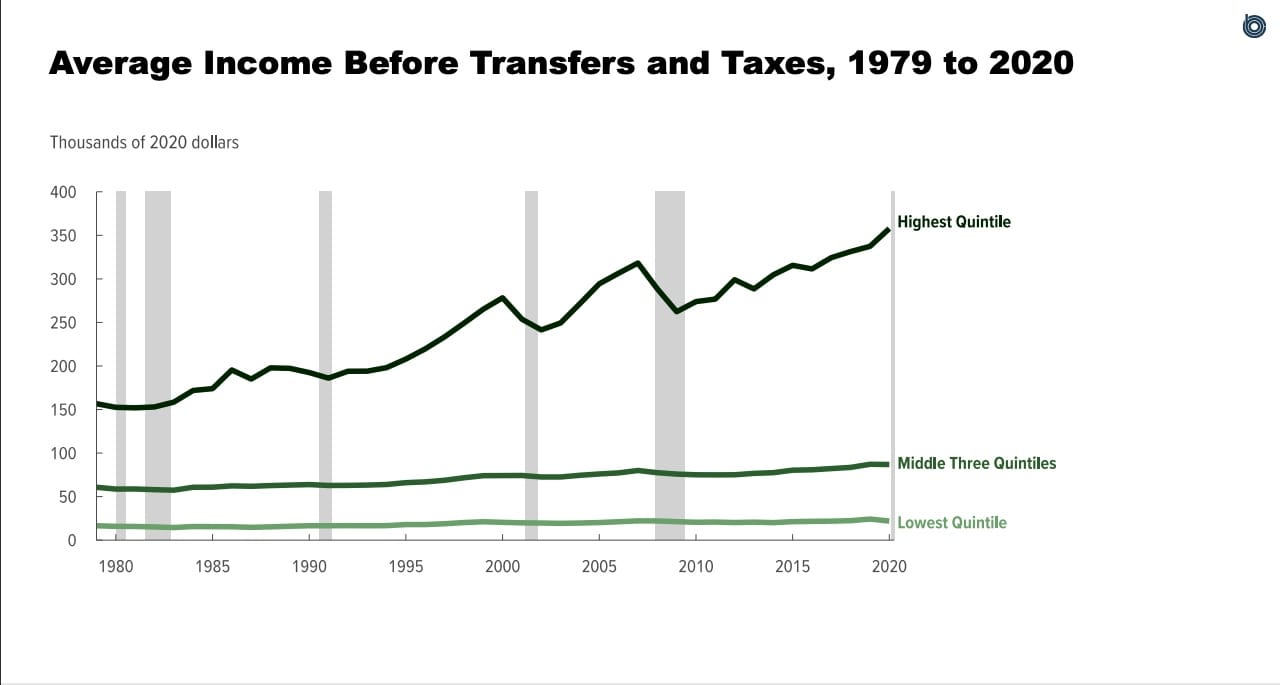
The beginning of that graph coincides with the presidency of Ronald Reagan. It also coincides with reforming the US economy around the idea that shareholder return is the metric to rule all others (Tolkien reference intended). The biggest cost to most companies is the cost of labour and the easiest way to keep it low (and thus give more money to shareholders) is to move production to where labour is the cheapest — i.e. not the US.
You can see the effect: in the 45 years since, income for the majority of Americans (the workers) has barely shifted, whereas the income for the top 20% has sky-rocketed. If you further separate out the top 1% and 0.1% (which is still 3.5M and 350,000 people) you need a larger page to see the top of the graph. Instead I’ll add another graph that shows the distribution of wealth in the US. That small black stain at the bottom: that is the bottom half of US households i.e. 175 million people.
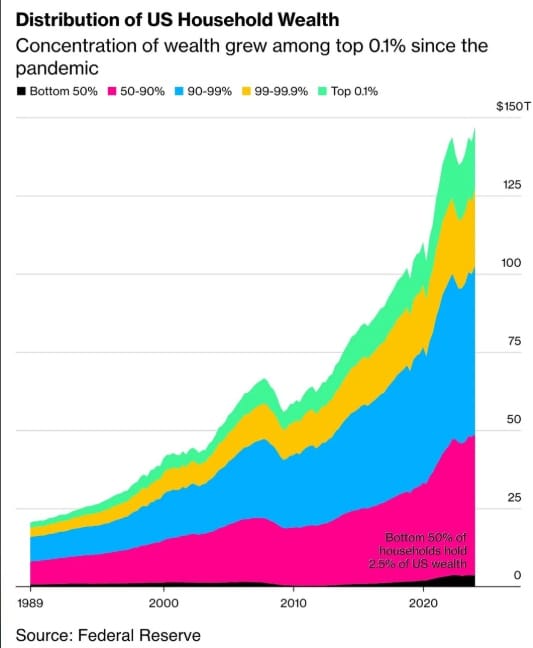
Quite simply, those at the very top of the economic ladder eviscerated the wealth of the middle class and added it to their own. (It is interesting to note that all dipped after the 2008 housing crash but that the burden of repayment fell on the bottom, thus keeping it flat for much longer)
So, while the tenet that actually built the US as a great nation was, “a rising tide lifts all boats,” the tenet that has controlled the billionaire business model in the US for the last 40 years has been, “is my super-yacht the biggest of all?”
The notion that minority groups could have brought this about would be laughable if it did not give rise to so much pain and conflict. And imagining that firing a few thousand government workers will put a dent in that graph while the people in the top have vacuumed up TRILLIONS of dollars, is risible.
And so, we find ourselves at a crossroads for America. And it is unfortunate that something that should not be political has become political. Or at least politics and identity have been turned into levers to sway the populace.
Yet the foundational question remains nonetheless: are we a NATION or are we a business?
Fear & Respect
Few people stop to consider the difference between fear and respect, because the behavior of those responding to either can look so similar. However, when you are respected, people, by and large, will follow you and obey orders, yet they will wish the best for you. But, when you are feared, people still and perhaps even more so will follow you and obey orders. Yet it would be foolish to forget that they do not wish the best for you, and they will gleefully watch your comeuppance and, perhaps, secretly plan it or support those who do.
In the years of America’s greatest greatness, we were respected. Everyone wanted to be us. Everyone (almost) was our friend and it gained us great benefits the world over. Now, I am concerned that we have decided to replace respect with fear, both within the US and beyond our borders. And although it may deliver us some short-term gains financially, (like a business) I am worried that, in the long-term, those gains will become very large losses (as a nation).
There is nothing wrong with wanting a secure national border. There is nothing wrong with wanting a fair shake in bilateral trading agreements. But nations, when run by great men and women around the world, consider the complexities of society in making their decisions – generally an inconvenience to the billionaire business model. ALL of us make up the United States, and only when everyone is being looked out for by their government can true greatness flourish.
The polemic that the granting of equal rights, respect and opportunity to small groups in our population has caused systemic problems in the world’s largest economy is only true to those that either don’t understand economics or those who choose to ignore and manipulate it for political or financial gain.
Calgacus, a tribal leader in Britain living under Roman Empire rule said, “They created a wasteland and called it peace.” That peace worked to fabulously enrich the 1% of Rome…until it didn’t. And then Rome found out just how many enemies they had created. FAFO as a Gen Z’er might say.
The massive assistance of the Marshall Plan made friendships that have endured for 80 years. The thinking that has Ukraine now being asked to pay for the assitance it was previously given, gives the impression of a protection racket. The world is watching...
A business looks for success by beating its competitors. Perhaps by burying them. A nation finds and maintains success by promoting flourishment for everyone and riding the resultant wave. At our greatest, that was us. And it endured until we killed it.
Will America choose to make itself a great nation again or might you and your loved ones be in the next group to be on the wrong side of a business decision?