Un-unAmerican
I love Italy. Specifically, I love visiting Italy. It’s difficult to put my finger on the special sauce, but the mix of history, architecture, fashion, food, wine, art and natural beauty is hard to beat. And the people and lifestyle seem much less stress-inducing than the US.
One thing that I have learned to get a chuckle out of is unreliability. Every time I have stayed in Italy, something has caused a need for a serviceperson to be called. Plumbing, heating, electrical, oh and the critical espresso machine repair chappie.
Initially, I focused on the aspect of Italian unreliable manufacturing. (Which, no matter what else I say, is still part of the truth.) But I also came to realize that Italy has a burgeoning service and repair economy. Stuff breaks down and someone has to fix it. I suspect that there is a whole generation or two of US mechanics who got to send their kids to ivy-league schools due to the large and consistent need for repairs to FIAT, Alfa-Romeo, Ferrari, Maserati, etc., vehicles. But in Italy, this seems to stretch to everything.
Years ago, I had a client that had developed a way to produce very high R-value (insulation) building-blocks from rice-straw. Rice straw is a waste-product generated from the production of rice; the burning of it in economies around the world is a colossal contributor to global warming. So, my client’s invention had some very important real-world applications. He took his prototype machine over to China to see if the government might be interested in large-scale production. As part of his discussions, he mentioned that the next generation of machine would be much more efficient and reduce the need for human involvement by several factors. The Chinese government official was horrified, “Nooo! We want to employ more people, not less.” —In China they are very conscious of the unrest that can be caused by unemployment and under-employment and strive hard to avert it.
I thought about this through the lenses of Italy and then the U.S. In the US, we have been accustomed (and encouraged) to look at business and life in general through the cold eyes of profit and efficiency. But when taken to its extremes that can lead to where the US is now. Instead of manufacturing items in the US that are made to have a long product life, via servicing and TLC, we are in a period of “buy, use, break, replace.” —of foreign manufactured goods. A few things, none good, happen because of this.
Firstly, an entire class of middle-class living has been wiped out. You don’t have to go back too far to remember appliance repair stores where you could take your TV, coffee-maker, vacuum etc. to have it repaired. They are now long-gone, because the price of repair is the price to replace (or maybe more). But it locks us into a short cycle of production and destruction. Things are cheaper because they are not built as well and not built to last or to be serviceable. (Note: I just tossed out a three-year old wine fridge that broke down and found out that the manufacturer does not even sell spare parts for it; their solution: buy another!)
This system works just fine for the billionaire economy because all the profits now move to the top – i.e. purchasing and replacing from the manufacturer/owner vs several generations of income flowing down to the middle classes (i.e. the trades-person) via service and repair. And so those skilled repair jobs shrivel up and instead of a father/mother passing along a skilled trade and going concern to their children, they all get to work in an unskilled job at an Amazon warehouse. This in addition to all the waste and environmental destruction caused by relentless production and disposal.
Alone is alone. Together is better.
I concede that I am painting with a rather broad brush here, but, without a doubt, the working class wields more power and has more protection in Italy than the US. Unions are a large part of the reason. Funnily enough, an important part of America becoming “the greatest” was the rise of the unions. As they say, if you like the weekend, thank a union. Through an at-times violent struggle, unions in the US clawed their way to significant power during the 1930s and for a forty-year period (with some admitted corruption along the way) delivered mightily for the US working man and woman.
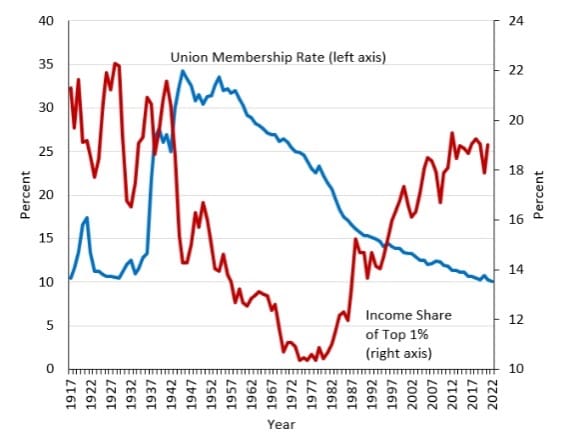
Since the 70s, a relentless campaign to turn workers against their unions has produced much fruit —though not for the workers… These efforts have produced a very significant downward force on the pay of working-class Americans. Large corporations in collusion with the politicians they finance have invested heavily in union-busting. In the 1950s, when the US maintained a large trade surplus with the rest of the world, union membership was at 35% with a much higher percentage of workers that were not union members nonetheless covered by union-negotiated contracts. Now, with our massive trade deficit, union membership stands at 9% (and only 6% in the private sector). You can see the effects on this US Treasury Department graph. (I don’t expect it to be online much longer…)
By comparison, in Italy, 34% of the population are union members and nearly 80% are covered by union agreements. Furthermore, entire industries negotiate agreements at once vs company by company.
I am not saying that everyone in Italy is lighting cigars with 50-Euro bills or that their economy is the lion of the world. But the working man and woman certainly get a fairer shake than workers in the US, where worker protections continue to be eroded and each worker becomes a negotiator of one against a corporation. As has already been proven in the early years of the above graph, the US economy got the best best from its workers as a whole, when the workers as a whole benefitted from it.
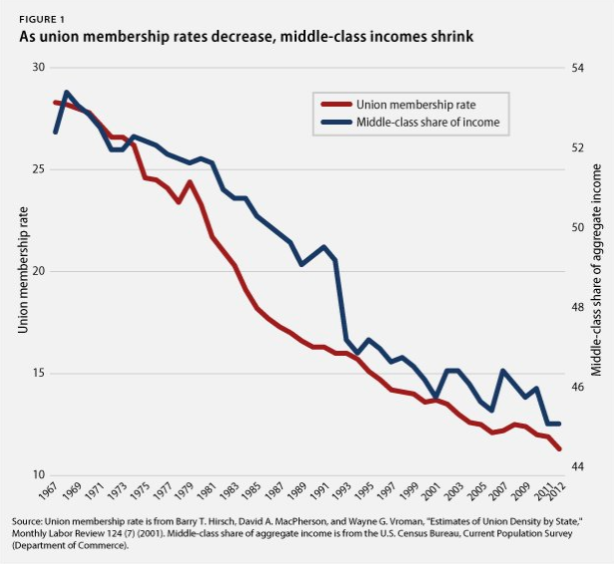
Unfortunately, as this graph shows, what has instead transpired is the billionaire dream. Increasingly as unions have been crushed, those at the very top vacuum up all the money and the rest of us fight over the remaining crumbs.
I recall the brilliant line from the movie The Usual Suspects: “The greatest trick the Devil ever pulled was convincing the world he didn’t exist.” Similarly, the greatest trick those that are sacking America ever pulled was convincing us that it is patriotic for each of us to stand alone against their corruption.
From what I understand, the American Revolution worked exactly the opposite way: they came together and fought against the regally privileged few for something better for all – and those guys are literally referred to as The Patriots!
Turns out that being an OG patriot means not letting a ruler and his (en)titled lords vacuum up all the wealth. It's past time to remember what flying our flag stands for.
—One Nation, not one percent.